

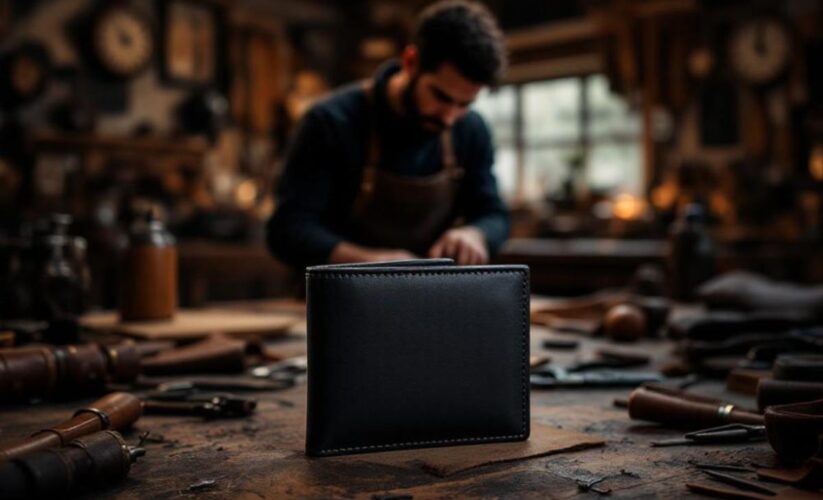
Craft and Care of Men’s Wallets: Right Choice Matters

Men’s wallets should be evaluated as engineered everyday-carry tools, not fashion accessories.
Most buyers are searching for the right craft and care men’s wallets. Which wallet lasts the longest, feels best daily, and justifies its price?
Choose high-grade leather (preferably full-grain), reinforced construction, disciplined capacity use, and consistent maintenance. A brand name alone is not enough.
Most wallets fail in 2–4 years. Edges crack. Stitching opens. Leather peels. Consumers assume all wallets are temporary. Poor material selection and weak structural engineering cause early failure, not time. The understanding craft, material science, structural stress points, and maintenance discipline.
Worldwide History of Men’s Wallets
Wallets evolved from simple coin pouches in the 1600s to structured billfolds after paper currency adoption in Europe and America.
| Era | Design Type | Primary Material | Key Shift |
| 1600s | Coin pouch | Leather | Carrying coins |
| 1800s | Early billfold | Tanned hide | Paper currency growth |
| 1950s | Classic bifold | Chrome-tanned leather | Credit cards introduced |
| 1990s | Designer wallets | Logo canvas/leather | Brand visibility |
| 2010s | Minimalist wallets | Slim leather/metal | Card-focused economy |
| 2020s | Smart wallets | RFID-blocking tech | Security & digital integration |
Institutions like the Smithsonian National Museum of American History have documented the evolution of wallets alongside payment systems.
Craft and Care of Men’s Wallets
| Category | What Matters Most | Why It Matters |
| Leather Grade | Full-grain or top-grain | Fiber density determines lifespan |
| Stitching | Tight, even, reinforced | Prevents seam failure |
| Fold Construction | Reinforced spine | Reduces cracking |
| Edge Finish | Burnished or layered paint | Protects from moisture |
| Maintenance | Conditioning 3–6 months | Prevents drying & cracking |
| Storage | Cool, breathable space | Avoids mold & warping |
Understanding the Craft: How Men’s Wallets Are Made
| Leather Type | What It Is | Key Characteristics | Durability Level | Aging Behavior | Commonly Used By | Best For |
|---|---|---|---|---|---|---|
| Full-Grain Leather | Top layer of the hide with natural grain intact | Thick fibers, no sanding, natural markings visible | Very High (8–15+ years with care) | Develops rich patina over time | Saddleback Leather Co., Bellroy | Long-term investment pieces |
| Top-Grain Leather | Slightly sanded upper layer of hide | More uniform surface, softer feel | High (5–10 years) | Subtle aging, less dramatic patina | Widely used in premium mid-range brands | Clean, modern aesthetic |
| Genuine Leather | Lower layers of hide; sometimes bonded scraps | Heavily coated surface, corrected grain | Moderate to Low (2–5 years) | Often cracks instead of aging naturally | Common in mass-market fashion brands | Budget-conscious buyers |
| Vegan Leather (PU/PVC) | Synthetic material made without animal hide | Plastic-based coating, uniform texture | Low to Moderate (1–3 years typical) | May peel or crack at fold points | H&M, Zara | Ethical/animal-free preference |
Types and prices of Men’s Wallets
| Wallet Type | Structure | Capacity Level | Thickness | Best For | Typical Price Range (USD) |
| Bifold | Folds once in the center | Medium | Medium | Everyday use | $40–$300+ |
| Trifold | Folds into three sections | High | Thick | Heavy card users | $50–$250+ |
| Slim / Cardholder | Flat, no major fold | Low | Very Thin | Minimalists | $25–$200+ |
| Money Clip Wallet | Clip + card slots | Low–Medium | Thin | Formal use | $30–$180+ |
| Front Pocket Wallet | Compact horizontal/vertical | Low | Thin | Comfort-focused | $30–$220+ |
| Travel Wallet | Larger format | High | Thick | Travelers | $60–$350+ |
| Zip Wallet | Zipper enclosure | Medium–High | Medium | Security-focused | $50–$300+ |
| Chain Wallet | Attached chain | Medium | Medium | Bikers/streetwear | $40–$220+ |
| Metal Wallet | Aluminum/titanium plates | Low | Very Thin | Tech/minimal users | $75–$250+ |
| Smart Wallet (RFID) | Slim + tech features | Low–Medium | Thin | Security-conscious | $80–$250+ |
Price vs Lifespan
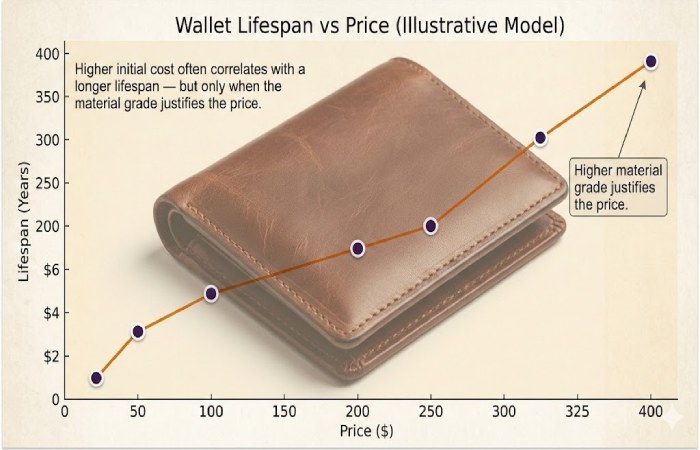
Higher initial cost often correlates with a longer lifespan — but only when the material grade justifies the price.
Care of Men’s Wallets: Extend Life by 5+ Years
| Care Category | What to Do | What to Avoid | Why It Matters |
| Conditioning (Every 3–6 Months) | Use a quality leather conditioner; apply a light, even layer; allow to absorb for 12 hours before reuse | Petroleum-based products; over-conditioning | Maintains moisture balance, prevents drying and cracking |
| Avoid Overstuffing | Carry only essential cards; remove coins; rotate wallets if needed | Filling all slots tightly; storing bulky receipts; sitting on thick wallet | Prevents stretching, seam stress, and permanent deformation |
| Back-Pocket Usage | Prefer front-pocket carry when possible | Sitting long hours on a thick wallet | Reduces fold spine stress, improves posture, avoids hip misalignment |
| Water Exposure | If wet, gently pat dry; air dry naturally; condition after drying | Direct heat (hair dryer, heater, sunlight) | Heat causes fiber shrinkage and irreversible cracking |
| Storage (When Not in Use) | Store in breathable cotton dust bag; keep in cool, dry place | Plastic bags; humid environments | Prevents mold growth, warping, and trapped moisture damage |
What Type of Wallet Is Best for Men?
It depends on lifestyle. A high-quality bifold made from full-grain leather balances capacity and structural stability. Since a wallet is often part of everyday clothing and personal style, it can also be useful to consider breathable wardrobe choices such as the benefits of wearing linen shirts when building a comfortable everyday look.
| Style | Capacity | Durability | Best For |
| Bifold | Moderate | High | Everyday carry |
| Trifold | High | Medium | Heavy card users |
| Slim Cardholder | Low | Very High | Minimalists |
| Money Clip | Low | High | Formal use |
| Smart Wallet | Low–Moderate | High | Tech users |
What are the Brands of wallets?
Below are reputable brands across tiers.
| Brand | Category | Avg Price (USD) | Specialty |
| Hermès | Ultra Luxury | $500–$2000 | Handcrafted leather |
| Louis Vuitton | Luxury | $400–$1200 | Coated canvas/leather |
| Bellroy | Premium Minimal | $80–$180 | Slim engineering |
| Saddleback Leather Co. | Heritage Rugged | $150–$300 | Thick full-grain |
| Ekster | Tech/Smart | $80–$250 | RFID & mechanisms |
| The Ridge | Metal Minimal | $75–$200 | Aluminum design |
| Tommy Hilfiger | Mid Fashion | $40–$120 | Branded leather |
Which Brand Wallet Is Best?
| Brand | Durability | Material Quality | Value for Money | Best For |
| Hermès | Exceptional | Exceptional | Low (premium pricing) | Collectors |
| Louis Vuitton | High | High | Moderate | Brand prestige |
| Bellroy | High | High | High | Professionals |
| Saddleback | Very High | Very High | High | Rugged users |
| Ekster | High | Moderate–High | High | Tech-savvy |
| The Ridge | High | Metal-based | High | Minimalists |
Best Overall Balance: Bellroy or Saddleback for durability-to-price ratio.
How to Find a Branded Wallet
Checklist:
- Buy from official brand websites.
- Verify stitching consistency.
- Check for authenticity cards.
- Examine packaging quality.
- Avoid suspicious discounts
How to Take Care of Branded Wallets
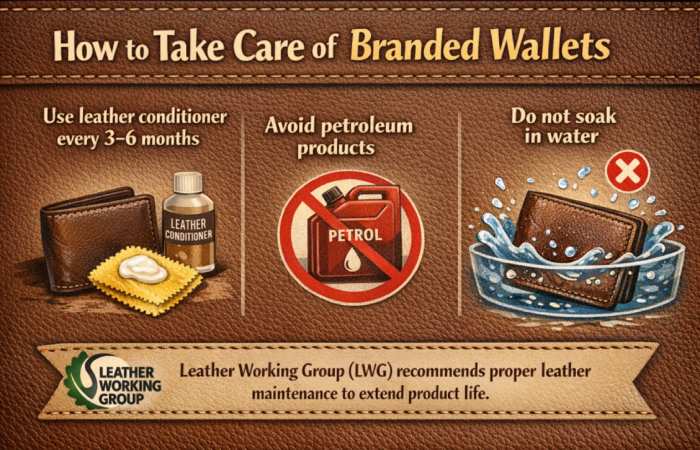
Preservation & Longevity Tips
| Action | Why |
| Avoid overstuffing | Prevents stretching |
| Rotate wallets | Reduces daily stress |
| Store in a cotton bag | Allows breathability |
| Air dry naturally | Prevents cracking |
| Clean gently | Maintains finish |
Pros & Cons of Wallets
| Pros | Cons |
| Long lifespan | High upfront cost |
| Develop patina | Require maintenance |
| Repairable | Can be stolen due to brand visibility |
| Better structure | Heavier (sometimes) |
Review
User patterns globally show:
- Minimalist wallets reduce back-pocket discomfort.
- Full-grain leather improves visually over time.
- Metal wallets protect cards but lack warmth.
- Fashion wallets often show edge cracking within 2–3 years.
Professional buyers prioritize durability over logo.
Specifications Checklist – Before Buying
| Specification | Ideal Standard |
| Leather Thickness | 1.4–1.8mm |
| Stitch Per Inch | Tight & even |
| Fold Reinforcement | Yes |
| RFID Blocking | Optional |
| Weight | Under 120g |
Final Perspective
A wallet is one of the few items you carry every single day, yet it’s often chosen casually. The right wallet is not just about appearance—it’s about structural durability, comfort, organization, and long-term value. When you prioritize quality materials, thoughtful construction, and proper care, a wallet can last a decade or more and age with character instead of falling apart. In the end, the best choice is the one that matches your lifestyle, avoids unnecessary bulk, and is built well enough that you replace it by preference—not by failure.
Frequently Asked Questions
- What type of wallet is best for men?
A full-grain leather bifold offers the best balance of durability, comfort, and capacity.
- How long should a good wallet last?
8–15 years with proper care.
- Is expensive always better?
No. Material quality and construction matter more than branding.
- Are metal wallets better than leather?
They are durable but less flexible and lack repairability.
- How often should I condition my wallet?
Every 3–6 months depending on climate and usage.