
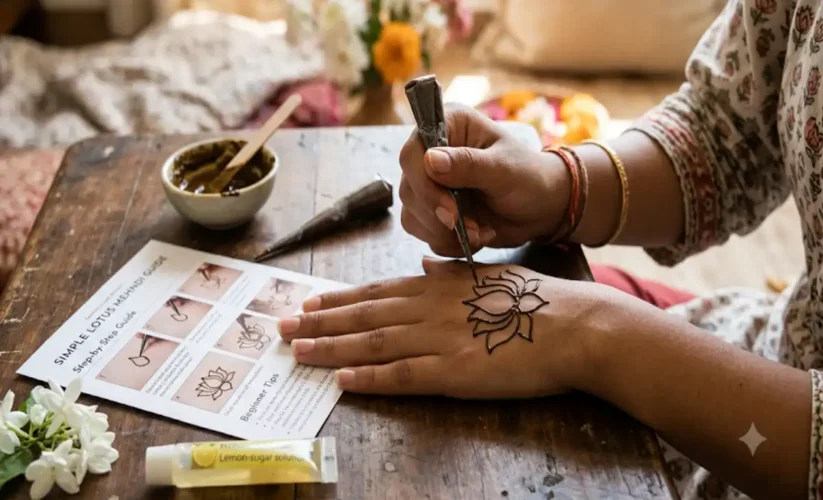
Lotus Flower Simple Lotus Mehndi Design: Step-by-Step Guide and Beginner Tips
When it comes to mehndi, we don’t always need intricate and elaborate motifs, shading work, and finger details. There is a lot of flair that can be achieved with just a small flower that is carefully designed on the palm. And the lotus is one such flower.
A lotus flower simple lotus mehndi design is especially suitable for beginners because its basic structure can be created using a few curved lines, pointed petals, and small decorative details. You can place it in the centre of your palm, on the back of your hand, near the wrist, or along a finger. Each placement creates a different look without requiring an entirely new design.
On this page, you will find easy design concepts, easy-to-follow drawing steps, placement tips and the step-by-step process of creating a clean lotus pattern – even if you’ve never picked up a mehndi cone!
What Makes Lotus Mehndi Designs Special?
The lotus is more than a beautiful flower pattern. For years, the lotus has played a prominent role in Indian fine arts, religious symbolism, architecture, and traditional decorative arts.
The lotus is symbolized in Indian cultural traditions as pure, beautiful, auspicious and spiritual development. Due to the lotus flower’s quality of growing out of dirty water which has made it a meaningful emblem of rising above limitations with elegance. It is also linked to the Goddess Lakshmi and features in many traditional artwork.
Visually, the lotus design has many benefits for the mehndi artist:
Recognizable shape: It’s easy to spot because it has fat, spoon-shaped, pointed petals.
Versatile styling: Yes, it is compatible with traditional & contemporary styles.
Easy to use: Basic grass, small grass can be generated by easy strokes.
Multi-direction: Perfect works on palms, back hands, wrists, and fingers.
How-toCustomize: Artists are able to include dots, leaf, circle, paisley and vines.
Another design principle is that the focus should be the lotus itself. The painting should not overwhelm the viewer and therefore cannot include too many decorative elements.
Quick Guide to Lotus Mehndi Designs
| Design type | Complexity | Ideal placement | Best for |
|---|---|---|---|
| Five-petal lotus | Very easy | Palm | Beginners |
| Mini lotus | Very easy | Fingers | Minimal look |
| Lotus with leaves | Easy | Back hand | Casual occasions |
| Lotus mandala | Medium | Centre palm | Festivals |
| Arabic lotus | Easy | Back hand | Modern styling |
| Lotus bracelet | Easy | Wrist | Family functions |
| Layered lotus | Medium | Back hand | Engagements |
| Lotus floral vine | Medium | Wrist and forearm | Weddings |
10 Beautiful and Simple Lotus Mehndi Design Ideas
The best way to choose a lotus pattern is to consider where you want to apply it and how much detail you prefer. Here are ten styles worth trying.
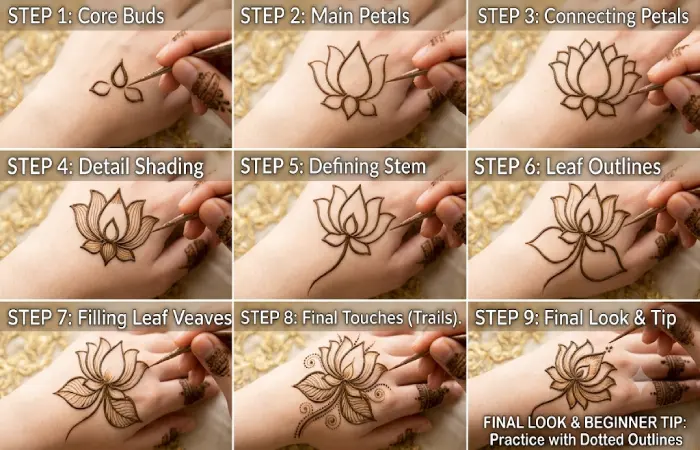
1. Simple Five-Petal Lotus Design
One of the simplest patterns for you to begin with. There is one larger middle petal with two side petals and two smaller petals behind.
Add a curved base under the flower to make it look natural. Fill in the petals or draw some light lines inside the petals.
Best placement: Middle of your palm, or the back of the hand.
2. Lotus with Miniature Leaves
If one flower seems too simple, add two pointy leaves underneath it. Make sure the leaves are leaning downward and use fine strokes to draw the patterns on them.
This blend gives a very balanced look for floral work without complicated designs.
Best placement: On the back of the hand or close to the wrist.
3. Small Lotus Finger Mehndi
You can also opt for a smaller lotus on the index or the middle finger if you want some mehndi design but less. Create a small floral design with three to five petal shapes and draw a dotted or thin vine connecting to it.
Don’t get into too many details as the finger space available is limited.
Best placement: index, middle, or ring finger.
4. Lotus Mandala Mehndi Design
This design uses the lotus with a circle of mandala lines. Create a centre circle and then place the pointed petals. Finish by placing the smaller petals for the second line.
Other options for decorating the outer edge are to add dots or little semicircles.
Best placement: Centre of the palm.
5. Lotus Mehndi Design in Arabic Style
Arabic design mehndi features free flowing patterns and a lot of open space. You can also place one or two lotus near the end of the wrist and run a winding vine towards the fingertips or the wrist.
Add small leaves, dots and curls along the vine. This will give an elegant look and you won’t get cover up the whole hand with tattoo.
Best placement: Back of the hand.
6. Lotus Wrist Mehndi Design
A lotus close to the wrist is similar to a ring on a finger. Create a tiny flower in the centre and then go with the flow with rounded lines.
You can add dotted lines or little leaves between the pattern. This is great if you want to keep the pattern in the palm of your hand.
Best placement: Wrist and lower forearm.
7. Lotus with Dotted Trails
Dotted lines are a quick way to add details to a plain lotus. Sketch the lotus, then include several curved dotted lines near it.
Towards the ends make the dots taper in size. This helps to ease the eye and give the design a weightless appearance.
Best placement: Back of the hand or side of palm.
8. Lotus Bud Mehndi Design
There are other ways to go. Even a closed lotus blossom can be a lovely and dainty design.
Draw two curved outer petals overlapped in front with a pointed top. Draw a short stem beneath and two small leaves. Or. Draw two or three buds along one of the curved vines.
Best placement: fingers, wrist, or hand’s side.
9. Large Lotus Back-Hand Design
If you desire a larger flower pattern, the bigger one on the back of the hand works well.
Five or seven prominent petals, with fine parallel strokes on them as inner details. Lower side extended towards wrist using leaves and curvilinear motifs.
What matters is to leave one or two empty rings so that the shape of the flower is clear.
Best placement: Centre of the back hand.
10. Lotus with Floral Vine Design
Incorporate one very large main lotus and one lush vine. Begin with the flower, then draw a curved line, reaching toward the fingers or wrist.
Add small leaves at various distances. You can also add small buds to produce a truly connected flower.
Best placement: Back of the hand extending toward the wrist.
Lotus Design Comparison
| Lotus design | Main features | Decoration options | Visual style |
|---|---|---|---|
| Five-petal lotus | Five pointed petals | Fine inner lines | Classic |
| Lotus with leaves | Flower and two leaves | Leaf veins and dots | Natural |
| Finger lotus | Small floral outline | Dotted trails | Minimal |
| Lotus mandala | Circular layered petals | Circles and borders | Traditional |
| Arabic lotus | Diagonal floral arrangement | Vines and curls | Contemporary |
| Wrist lotus | Central flower | Bracelet-style curves | Delicate |
| Dotted lotus | Open flower | Small dots | Simple |
| Lotus bud | Closed petals | Stem and leaves | Subtle |
| Large lotus | Prominent layered petals | Shading and outlines | Statement |
| Floral vine lotus | Flower with connected vine | Buds and leaves | Decorative |
How to Draw a Simple Lotus Mehndi Design Step by Step
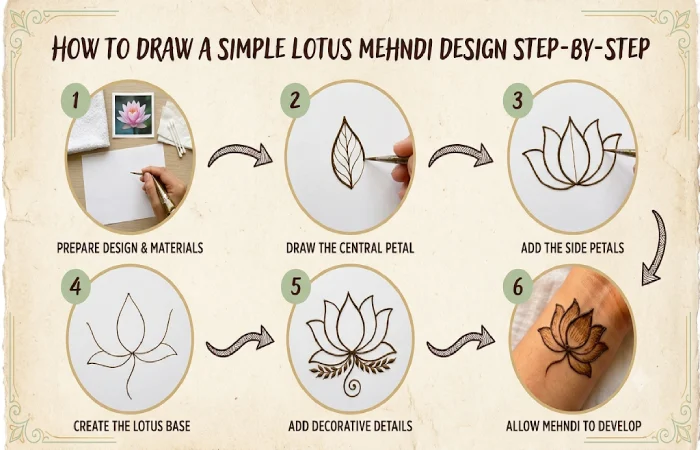
Creating a neat lotus does not require advanced drawing skills. The secret is to build the flower gradually instead of trying to complete every detail in one attempt.
Follow these steps to create your first design.
Materials Required for Lotus Mehndi
Before applying mehndi, keep the following items ready:
| Material | Purpose | Beginner tip |
|---|---|---|
| Henna cone | Applying the design | Choose a fine-tip cone |
| Practice paper | Testing patterns | Practise petal shapes first |
| Tissue paper | Cleaning small mistakes | Keep it nearby |
| Reference picture | Understanding flower structure | Choose a clear lotus outline |
| Cotton buds | Cleaning minor smudges | Use gently before the paste dries |
| Clean towel | Preparing the hand | Ensure the skin is dry |
- Step 1: Prepare Your Design and Materials
- Step 2: Draw the Central Petal
- Step 3: Add the Side Petals
- Step 4: Create the Lotus Base
- Step 5: Add Decorative Details
- Step 6: Allow the Mehndi to Develop
Best Hand Placements for Lotus Mehndi
Choosing the correct placement can make a simple flower look much more attractive. The same lotus pattern may appear delicate on a finger but become a statement design when placed in the centre of the palm.
| Hand placement | Design suggestion | Overall appearance |
|---|---|---|
| Front palm | Round lotus or mandala | Traditional |
| Back hand | Large outlined lotus | Elegant |
| Fingers | Tiny lotus buds | Minimal |
| Wrist | Lotus with curved vines | Bracelet-like |
| Side of palm | Diagonal lotus trail | Modern |
| Lower forearm | Lotus with leafy branches | Decorative |
Front-Hand Lotus Placement
The front palm provides enough space for a rounded flower. A central lotus with a few surrounding dots or leaves creates a traditional appearance.
Back-Hand Lotus Placement
The back of the hand is suitable for larger, more visible patterns. A diagonal arrangement can also create a graceful connection between the wrist and fingers.
Finger Lotus Placement
Finger designs work best when the flower is small and uncomplicated. Use a few petals and simple lines rather than attempting a detailed mandala.
Design Selection by Occasion
| Occasion | Recommended lotus design | Suggested details |
|---|---|---|
| Everyday wear | Small lotus | Simple outline |
| College functions | Finger lotus | Dots and tiny leaves |
| Festivals | Lotus mandala | Circular borders |
| Engagement | Large back-hand lotus | Layered petals |
| Wedding guest look | Arabic lotus | Floral vines |
| Family celebrations | Lotus with leaves | Curved branches |
| Traditional ceremonies | Front-palm lotus | Symmetrical petals |
| Casual parties | Wrist lotus | Bracelet-style pattern |
Common Mistakes to Avoid When Drawing Lotus Mehndi
A lotus may look simple, but a few small mistakes can change its appearance considerably.
| Common problem | Why it happens | How to fix it |
|---|---|---|
| Uneven petals | Inconsistent spacing | Use the central petal as a guide |
| Flower looks like a daisy | Petals have similar shapes | Make the central petal taller |
| Thick outlines | Excessive cone pressure | Apply gentle, steady pressure |
| Crowded design | Too many decorative details | Leave negative space |
| Smudged lines | Touching wet mehndi | Allow the paste to dry undisturbed |
| Unbalanced flower | Side petals are different sizes | Practise the outline on paper |
| Weak floral appearance | Flower lacks a defined base | Add a shallow curved base |
Another tip: start by drawing the flower and observing it from a close distance before playing around with it. If the lotus looks good enough on its own, then you will be set.
Mehndi Application and Skin Safety
If it is gorgeous, it doesn’t have to be painful! Select items with clear labeling and stay away from blends labeled as instant-black or black henna. The US Food and Drug Administration says certain black henna preparations use the hair dye-ingredient para-phenylenediamine (PPD), which can cause severe damage to the skin such as blistering and scarring.
Keep these precautions in mind:
- Inquire with the artist about what has been used in the henna paste.
Avoid products containing PPD for skin application.
Do not use mehndi on skin that is sore, broken, or damaged.
Discontinue use if burning, itching or other abnormal irritation occurs.
Get medical attention if a major skin reaction occurs.
More natural brown or reddish-brown stains are a feature of regular henna rather than a production of a very black stain. But colour alone does not indicate a product is safe.
Frequently Asked Questions
1. Which lotus mehndi design is easy?
The easy option is the plain five-petal lotus. All you need is a central petal, two side petals, two smaller outer petals and a curved base. You can start to add leaves and dots once you’re confident with the shape.
2. Where do you put a lotus mehndi design?
Two common placements include the middle of the palm and the back of the hand. The palm lends itself to circular lotus motifs, while the back of the hand allows for a more elaborate tattoo with larger flowers and swirling vines. Small lotus buds also look great on the fingers and wrists.
3. Can I make a lotus pattern without filling in the petals?
Yes. I like a outlined lotus with empty petals. Using inner line detail or dot work, the occasional thin line within each petal creates detail without covering up the whole flower.
4. Can a lotus mehndi be applied for a wedding?
Yes. Lotus designs work well on wedding guest, engagement, festival and bridal mehndi. For a simple wedding style, use a layered lotus with leafy vine details. On bridal mehndi, the flower can be used as a component of a bigger mandala or floral design.
Final Thoughts
A lotus is a lovely illustration of the many simple designs that can come together to form a sophisticated mehndi design without any drawings. A small finger flower, a palm mandala or a larger back-hand design – a lotus can lend itself to much variation.
Here’s what to look for when selecting a lotus flower simple lotus mehndi design: Even petals, clear line work, and positioning. The finer details (hues, glitter, and embellishments) aren’t as important.
In the end, the most beautiful mehndi design isn’t the intricatest, it’s the one that shows who you are and onlyuses the lotus flower to show off!