


15 High Paying Jobs That Don’t Require a Degree Today

High-paying jobs that don’t require a degree are not rare exceptions—they are structured career paths in trades, technology, transportation, public safety, and entrepreneurship where skills, licensing, and performance matter more than formal education. If you optimize for Certification, market demand, and income scalability, you can realistically earn ₹6–25 LPA in India or $60,000–$120,000+ in the US without a traditional college degree.
What “High Paying” Actually Means?
United States
According to data from the US Bureau of Labor Statistics, the median annual wage across all occupations is roughly $48,000–$50,000.
For this article, “high paying” means:
- $60,000+ annually
- With upside to $90,000–$120,000+
India
For India, where the median income is significantly lower, “high paying” typically means:
- ₹6 LPA and above
- With growth potential beyond ₹15–25 LPA
The 5 Categories of High-Paying Jobs Without a Degree
Instead of random listings, think in categories:
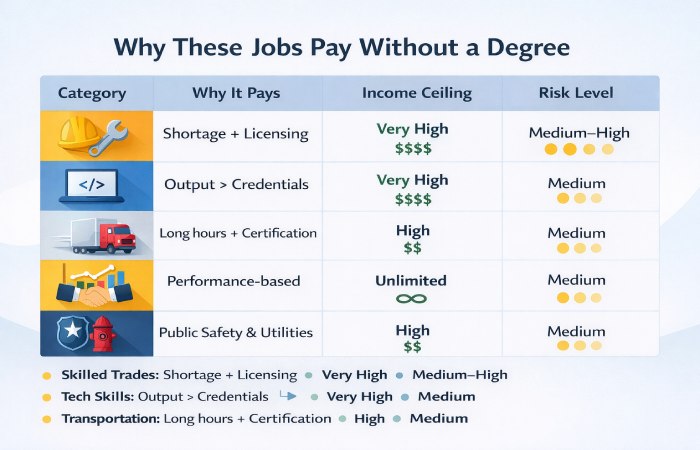
| Category | Why It Pays | Income Ceiling | Risk Level |
| Skilled Trades | Shortage + Licensing | Very High | Medium–High |
| Tech Skills | Output > Credentials | Very High | Medium |
| Transportation | Long hours + Certification | High | Medium |
| Sales & Commission | Performance-based | Unlimited | Medium |
| Public Safety & Utilities | Structured promotions | High | Medium |
Now, let’s break down real options.
1. Skilled Trades (The Hidden Millionaire Path)
| Skilled Trade | United States – Typical Salary Range | India – Typical Salary Range | Where Income Is Highest (US) | Where Income Is Highest (India) | Why It Pays Well |
| 1. Electrician | $60,000–$80,000+ (Master electricians can exceed $100,000) | ₹4–12 LPA (independent contractors earn more) | California, New York, Texas (large construction & renewable energy markets) | Mumbai, Bengaluru, Delhi NCR, Hyderabad | Infrastructure expansion, solar & EV installations, constant maintenance demand |
| 2. Plumber | $55,000–$75,000+ (Emergency/commercial roles much higher) | ₹5–15 LPA (metro areas) | Illinois, California, Massachusetts | Mumbai, Pune, Chennai, Delhi NCR | Essential services, shortage of young skilled workers, urban housing demand |
| 3. Elevator & Escalator Installer | $80,000–$100,000+ (unionized roles higher with overtime) | ₹6–18 LPA (large infrastructure projects) | New York, Illinois, Washington | Mumbai, Delhi NCR, Bengaluru | Technical complexity, safety risk, limited workforce supply |
| 4. HVAC Technician | $50,000–$85,000+ (commercial HVAC higher) | ₹4–10 LPA | Texas, Florida, Arizona (hot climate states) | Hyderabad, Ahmedabad, Chennai | Climate demand, commercial cooling systems, urban construction growth |
Key Insight
- US income ceiling is significantly higher due to unionization, licensing premiums, and structured apprenticeship systems.
- India offers strong growth in metro cities, especially for contractors who move into commercial or infrastructure projects.
- The highest earners in all four trades typically:
- Become licensed specialists
- Move into commercial contracts
- Start their own service businesses
2. Technology & Transportation Jobs Without a Degree
| Role | United States Salary Range | India Salary Range | Key Certifications / License | Major Hiring / Regulating Body | Income Growth Potential |
| 5. Web Developer | $65,000–$110,000+ | ₹5–20 LPA | Portfolio-based hiring (HTML, CSS, JavaScript, React, backend frameworks) | Companies like Google and IBM increasingly use skills-based hiring | Very High (freelance, remote, SaaS projects) |
| 6. Cybersecurity Analyst | $70,000–$120,000+ | ₹6–25 LPA | CompTIA Security+, CEH, Google Cybersecurity Certificate | Enterprise IT firms, banks, MNCs | Very High (security architects earn far more) |
| 7. Cloud Support Associate | $65,000–$105,000+ | ₹6–22 LPA | AWS Cloud Practitioner, Azure Fundamentals | Amazon Web Services and other cloud providers | Very High (DevOps / Cloud Engineer path) |
| 8. Commercial Truck Driver | $60,000–$90,000+ (specialized hauling higher) | ₹4–12 LPA | CDL (US), Heavy Vehicle License (India) | State transport authorities | Medium–High (Owner-operator model increases earnings) |
| 9. Commercial Pilot | $90,000–$250,000+ (captains higher) | ₹20 LPA–₹1 crore+ | Commercial Pilot License (CPL) | Regulated by Directorate General of Civil Aviation (India) | Extremely High (Senior captain level) |
Strategic Insight
- Tech roles = highest scalability due to remote work, global clients, and specialization.
- Cloud & cybersecurity are structurally growing fields because of digital transformation and regulatory pressure.
- Transportation roles trade flexibility for income stability, with long hours but strong demand.
- Commercial aviation has the highest ceiling, but the biggest upfront investment.
3. Sales: The Performance Career
| Role | United States Income Range | India Income Range | Degree Required? | Licensing / Entry Barrier | What Drives High Income | Income Scalability |
| 10. Real Estate Agent | $50,000–$150,000+ (top metro agents significantly higher) | ₹5–25 LPA+ (top metro brokers earn far more) | No | Real estate license required (state-specific in US; state RERA registration in India) | Negotiation skills, local market expertise, strong network, high-value property deals | Very High (commission-based, unlimited upside) |
| 11. Tech Sales / SaaS Sales | $80,000–$150,000+ (base + commission; enterprise roles higher) | ₹8–30 LPA (enterprise SaaS higher) | No (skills-based hiring common) | Product training + CRM proficiency; no formal licensing | Product knowledge, closing ability, communication, pipeline management | Extremely High (performance bonuses, enterprise contracts, global markets) |
Strategic Insight
- Real estate rewards local dominance — top earners build reputation in specific micro-markets.
- Tech/SaaS sales rewards scalability — you can sell globally, remotely, and at enterprise contract sizes.
- In both careers, income ceiling depends more on performance than credentials.
- Unlike fixed-salary jobs, these roles favor:
- Risk tolerance
- Relationship building
- Consistent lead generation
4. Public Safety & Government Roles
| Role | United States Salary Range | India Salary Range | Regulating / Example Authority | Degree Required? | Key Benefits | Income Growth Drivers |
| 12. Police Officer | $55,000–$110,000+ (varies by city, rank & overtime) | ₹4–15 LPA (higher with promotions & special units) | Example: New York Police Department (US); State Police Departments (India) | No (academy training required; some departments prefer credits but not mandatory) | Pension plans, healthcare, job stability, structured promotions | Rank advancement (Sergeant, Lieutenant), overtime, specialized units (SWAT, cybercrime) |
| 13. Firefighter | $50,000–$100,000+ (metro areas higher with overtime) | ₹4–12 LPA (government roles; metro corporations higher) | City/State Fire Departments (US & India) | No (physical & academy training required) | Strong union protections (US), pension, shift-based schedules | Overtime, hazard pay, promotions (Captain, Battalion Chief), specialized rescue units |
Key Insight
- These roles offer income stability + retirement security, which many private-sector jobs don’t guarantee.
- Overtime and rank progression significantly increase lifetime earnings.
- Unlike commission-based careers, these roles prioritize structured growth and long-term benefits over rapid income spikes.
- Physical fitness and mental resilience are often more important than formal education.
5. Digital Creator & Online Business
| Role | Primary Platform / Market | United States Income Potential | India Income Potential | Degree Required? | Main Income Streams | What Determines Earnings | Income Stability | Scalability |
| 14. YouTube Content Creator | YouTube | $0–$150,000+ annually (top creators far higher) | ₹0–₹50 LPA+ (top creators much higher) | No | Ads (AdSense), sponsorships, digital courses, affiliate marketing, memberships | Niche selection, audience retention, content consistency, monetization strategy | Low in early stage, improves with audience size | Extremely High (global reach, brand expansion, product launches) |
| 15. Freelance Specialist (SEO, Copywriting, Video Editing, Paid Ads) | Global freelance marketplaces & direct clients | $30,000–$200,000+ depending on niche | ₹4–₹40 LPA+ depending on niche & client type | No | Project fees, retainers, performance bonuses, consulting | Specialization, results delivered, reputation, client acquisition skills | Medium (if retainer-based) | Very High (agency model, productized services, team scaling) |
Strategic Insight
- YouTube is asset-based income — you build an audience once and monetize repeatedly.
- Freelancing is skill-based income — you monetize expertise immediately but must continuously acquire clients.
- Both paths:
-
-
- Require zero formal degree
- Demand consistency and self-discipline
- Offer uncapped upside
-
Apps Where You Can Apply For These Jobs?
| Job Category | Apps / Platforms | What You Can Find |
| General Job Search (tech, sales, public safety, trades) | Full-time jobs across industries with networking, recruiter contacts. | |
| Indeed | Millions of listings for salaried and hourly jobs, including tech, sales, and safety roles. | |
| ZipRecruiter | AI-matched jobs with alerts; broad coverage across sectors. | |
| Glassdoor | Job listings plus company reviews and salary insights. | |
| Skilled Trades & Local Services | Thumbtack for Professionals | Find gigs and contractor jobs for plumbers, electricians, HVAC, handyman tasks. |
| Steady | App for part-time, hourly and independent work listings (US only). | |
| Tech & Specialized Roles | Dice | Tech-focused job search (developers, cybersecurity, cloud). |
| AngelList / Wellfound | Startup jobs including SaaS sales, dev, remote tech roles. | |
| Freelance & Gig Work | Upwork | Apply to freelance projects in web dev, marketing, design, tech. |
| Fiverr | Sell services (SEO, copywriting, video editing, consulting). | |
| Freelancer.com | Bid on freelance projects globally. | |
| PeoplePerHour | Project-based freelance gigs. | |
| Kwork / 24Task | Mobile-friendly freelance gig platforms. | |
| Sales & Startup Roles | RemoteQuota / RepVue | Niche sales role boards and community-driven listings (popular in sales circles). |
| Company Career Sites | Direct applications often yield faster responses (especially for SDR/AE roles). | |
| Gig / Local On-Demand Work | Jooble | Aggregates jobs from 100s of sources for local or remote work. |
| Switch | Swipe-style job discovery and matching app. |
Income Comparison
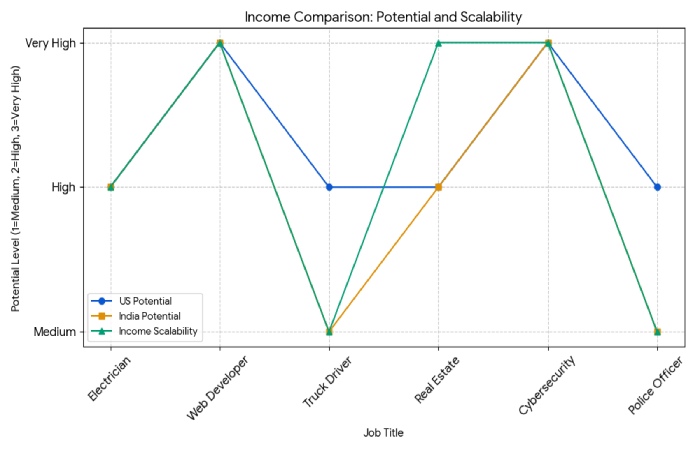
| Job | US Potential | India Potential | Training Required | Income Scalability |
| Electrician | High | High | Apprenticeship | High |
| Web Developer | Very High | Very High | Self-taught / Certs | Very High |
| Truck Driver | High | Medium | License | Medium |
| Real Estate | High | High | License | Very High |
| Cybersecurity | Very High | Very High | Certifications | Very High |
| Police Officer | High | Medium | Academy | Medium |
Jobs That Look High Paying But Often Aren’t
Be cautious of:
- Entry-level digital marketing without specialization
- Dropshipping hype
- Low-tier call center roles
- Generic “data entry” jobs
High pay requires:
- Specialization
- Scarcity
- Measurable skill
How to Choose the Right Path?
Ask:
- Do you prefer physical or desk work?
- Are you okay with certification exams?
- Do you want predictable salary or commission upside?
- Can you invest 6–18 months in training?
If you want:
- Fast income: Skilled trades
- Remote flexibility: Tech
- Unlimited upside: Sales or entrepreneurship
- Stability: Public safety
Reviews
Here are simple, relatable reviews on High Paying Jobs That Don’t Require a Degree Today — perfect for social proof or a testimonials section:
- “I became an electrician without a degree and now earn more than many of my college-educated friends.”
- “Plumbing gave me financial freedom — I learned on the job and quickly increased my earnings.”
- “I entered cybersecurity through certifications and now work with top firms without a CS degree.”
- “Tech sales taught me that communication and grit matter more than a diploma.”
- “As a commercial truck driver, I earn a great income with flexibility and no degree requirement.”
- “Real estate allowed me to build my network and income at my own pace.”
- “I trained as an HVAC technician and now have steady, high paying work year-round.”
- “Freelancing in web development gave me control over clients and earnings without college.”
- “Becoming a firefighter gave me job stability, benefits, and overtime income — no degree needed.”
- “YouTube content creation took time, but now multiple income streams pay well without formal education.”
Final Perspective
The biggest myth about high-paying jobs that don’t require a degree is that they are shortcuts—they’re not. These careers demand real commitment: discipline, licensing, apprenticeships, portfolio building, and continuous learning. The difference is that they remove one major barrier—a 3–4 year college investment before you even begin earning. As skills-based hiring expands globally, with companies increasingly prioritizing proven ability over formal credentials, the opportunity gap continues to narrow.
In 2026 and beyond, if you choose a high-demand field, invest in certifications or hands-on training, and commit to mastering your craft, a non-degree path can not only compete with traditional graduates—it can outperform them financially and in long-term career flexibility.