

Ultimate Mehndi Design Guide: Traditional to Instagram Trends

Mehndi design refers to decorative patterns created on the skin using natural henna paste derived from the Lawsonia inermis plant. These designs are traditionally applied on hands and feet during cultural celebrations such as weddings, extravaganzas, and religious events.
What Is Mehndi Design?
Mehndi is a temporary body art technique created using a paste made from powdered henna leaves. When applied to the skin, the dye molecules bind to keratin, leaving a reddish-brown stain that lasts between 1–3 weeks.
The art form has deep roots across South Asia, the Middle East, and North Africa, where mehndi is traditionally used during:
- Weddings
- Festivals
- Religious ceremonies
- Cultural celebrations
- Fashion and beauty events
While its origins are ancient, mehndi design has evolved into a global beauty trend, widely seen in bridal styling, fashion shoots, and modern body art.
History and Cultural Significance of Mehndi
The use of henna dates back over 5,000 years. Archaeological evidence suggests its use in ancient Egypt, where it was applied for cosmetic and ceremonial purposes.
Historically, mehndi symbolized:
| Symbolism | Meaning |
| Prosperity | Good fortune and blessings |
| Love | Especially in bridal ceremonies |
| Protection | Spiritual safeguarding |
| Joy | Celebration and happiness |
In traditional weddings, intricate mehndi designs are believed to bring luck, happiness, and prosperity to the couple.
Common Mehndi Design Styles
| Style | Key Characteristics | Best For |
| Arabic Mehndi | Bold floral patterns, spaces between elements | Beginners |
| Indian Mehndi | Dense, detailed motifs and storytelling | Bridal designs |
| Pakistani Mehndi | Mix of Indian and Arabic elements | Formal events |
| Moroccan Mehndi | Geometric lines and symmetry | Modern minimal looks |
| Indo-Western Mehndi | Fusion patterns and creative layouts | Fashion events |
The depth of color and longevity of mehndi depend on henna quality, application technique, and aftercare.
Types of Mehndi Designs
| Mehndi Design Type | Key Characteristics | Difficulty Level | Best For |
| Arabic Mehndi | Bold floral patterns, flowing vines, lots of open spaces | Beginner | Festivals, casual events |
| Indian Mehndi | Dense patterns, paisleys, peacocks, intricate details | Advanced | Bridal mehndi |
| Pakistani Mehndi | Combination of Arabic flow and Indian detailing | Intermediate | Weddings and engagements |
| Moroccan Mehndi | Geometric shapes, symmetry, straight lines | Intermediate | Modern and minimalist styles |
| Indo-Western Mehndi | Fusion of traditional motifs with modern designs | Beginner–Intermediate | Fashion events |
| Bridal Mehndi | Extremely detailed designs covering hands and feet | Advanced | Weddings |
| Minimal Mehndi | Small motifs, simple lines, elegant spacing | Beginner | Everyday wear |
| Jewelry Mehndi | Bracelet, ring, and hand jewelry-inspired patterns | Beginner | Parties and modern looks |
| Finger Mehndi | Designs focused mainly on fingers | Beginner | Quick mehndi styles |
| Mandala Mehndi | Circular mandala pattern centered on palm | Beginner–Intermediate | Festivals and simple bridal looks |
Mehndi Design Price
| Mehndi Design Type | Average Price (INR) | What’s Included | Best For |
| Minimal Mehndi | ₹200 – ₹400 per hand | Small motifs, finger designs | Casual events |
| Arabic Mehndi | ₹300 – ₹800 per hand | Floral patterns with open spaces | Festivals |
| Simple Full Hand Mehndi | ₹800 – ₹1,500 | Palm to wrist designs | Parties, small functions |
| Traditional Full Hand Mehndi | ₹1,200 – ₹2,500 | Dense patterns up to elbow | Engagements |
| Feet Mehndi | ₹800 – ₹1,800 | Ankle-to-toe designs | Weddings |
| Bridal Mehndi | ₹5,000 – ₹15,000 | Both hands and feet with detailed patterns | Brides |
| Premium Bridal Mehndi | ₹20,000 – ₹50,000+ | Portraits, custom themes, luxury designs | High-end weddings |
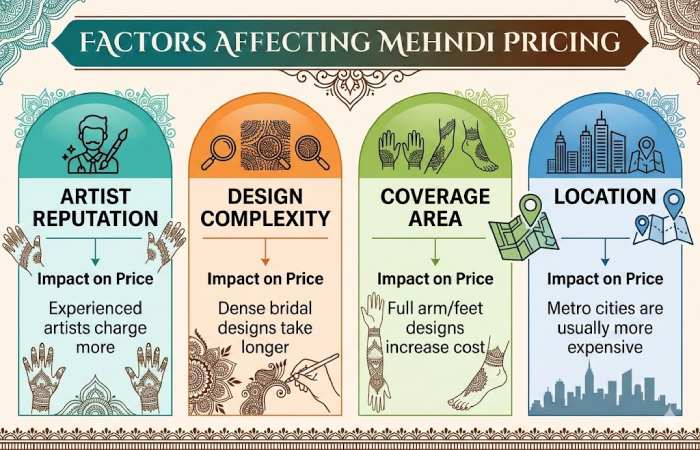
In cities like Delhi or Mumbai, simple mehndi may cost ₹800–₹1,500 per hand, while bridal mehndi packages can range from ₹8,000 to ₹25,000 or more depending on the artist’s experience and design complexity.
During festivals or local markets, mehndi application may start from ₹300 per hand and go up to ₹3,500+ for intricate designs.
Factors That Affect Mehndi Prices
Well-known Mehndi (Henna) Artists
| Mehndi Expert | Country/City | Specialty | Why They Are Famous |
| Veena Nagda | Mumbai, India | Bridal and celebrity mehndi | Known as the “Mehendi Queen”; has designed mehndi for celebrities like Deepika Padukone and major Bollywood weddings. |
| Ash Kumar | United Kingdom | Fast bridal mehndi | Guinness World Record holder for the fastest mehndi application and popular for Bollywood-style designs. |
| Darcy Vasudev | California, USA | Fusion and boho henna | Known for blending traditional henna with modern Western body-art styles. |
| Divya Patel | Canada | Minimalist bridal mehndi | Famous for modern floral and geometric mehndi patterns. |
| Hiral Shah | Dubai, UAE | Arabic and glitter mehndi | Popular for luxury bridal mehndi and destination weddings. |
| Manisha Modi | India | Bridal designer mehndi | Known for creative styles like zardozi, shaded, and Arabic designs. |
| Jayprakash Singh | Delhi, India | Traditional Indian mehndi | Over two decades of experience using natural henna for long-lasting bridal designs. |
Websites to Download Mehndi Designs
| Website | What You Can Find | Best For |
| Simple Mehendi | 2000+ curated mehndi patterns including Arabic, bridal, and festival designs | Beginners and inspiration galleries |
| MehndiGallery.in | 1000+ images such as front hand, back hand, and royal bridal mehndi designs | Downloadable HD design photos |
| MehndiDesignStore | Large collection of mehndi photos and tutorial articles | Design ideas and tutorials |
| Mehendi Gallery | Latest mehndi designs, videos, and beauty articles | Trending mehndi inspiration |
| Mehendi Bazar | Bridal, Arabic, festival, and celebrity-inspired mehndi designs | Event-based mehndi ideas |
| MehndiDesigning.com | Mehndi tutorials, design collections, and tips for beginners | Learning and practice resources |
Many of these sites host large galleries of categorized designs, such as Arabic, bridal, and festival mehndi patterns, allowing users to browse and download images for inspiration or practice.
YouTube Channels to Learn Mehndi Step-by-Step
| YouTube Channel | What They Teach | Best For |
| Henna Beauty | Complete beginner classes, cone control, basic patterns | Beginners learning fundamentals |
| Saloni’s World | Daily mehndi tutorials including Arabic and bridal designs | Learning new designs regularly |
| MehndiArtistica | 1000+ videos on floral, bridal, and modern mehndi styles | Intermediate learners |
| Henna Art by Aroosa | Detailed step-by-step henna tutorials | Beginners and bridal artists |
| Priya Dasila Mehendi | Daily tutorials on back hand and party mehndi designs | Practicing new patterns |
| Sunitha’s Mehendi Art | Professional tutorials with hundreds of videos | Advanced learning |
Several creators publish step-by-step tutorials showing how to draw patterns, prepare henna cones, and create bridal or Arabic mehndi designs, making YouTube one of the best platforms to learn mehndi visually.
Popular Mehndi Design Trends
Modern mehndi trends emphasize minimalism, personalization, and creativity. These trends are heavily influenced by social media platforms and bridal fashion industries.
| Trend | Description |
| Minimal mehndi | Small, delicate designs |
| Jewelry mehndi | Bracelet and ring patterns |
| Personalized bridal mehndi | Names and dates hidden in designs |
| White henna | Cosmetic body paint look |
| Glitter mehndi | Decorative festival style |
Mehndi Design Ideas by Occasion
Matching the design style with the event enhances overall aesthetics.
| Occasion | Suggested Style |
| Wedding | Indian bridal mehndi |
| Engagement | Pakistani designs |
| Festival | Arabic floral mehndi |
| Casual event | Minimal finger mehndi |
| Fashion shoots | Indo-Western fusion |
Essential Mehndi Design Elements
Understanding common motifs helps artists create balanced patterns. These motifs form the building blocks of most mehndi compositions.
| Motif | Meaning | Use in Designs |
| Paisley | Fertility and growth | Bridal patterns |
| Mandala | Universe and harmony | Palm centerpieces |
| Peacock | Beauty and elegance | Wedding designs |
| Flowers | Joy and celebration | Arabic styles |
| Leaves and vines | Growth and prosperity | Flow patterns |
How to Apply Mehndi?
1: Prepare the Skin
Clean the skin using soap or alcohol wipes to remove oils.
| Preparation Tip | Why It Matters |
| Avoid lotion | Prevents stain blockage |
| Dry skin fully | Improves henna absorption |
2: Prepare the Henna Cone
Use fresh henna paste in a plastic cone applicator.
The cone tip should allow thin, controlled lines.
3: Start With Basic Shapes
Beginners should practice these shapes first:
- Dots
- Lines
- Leaves
- Spirals
These elements combine to form most mehndi designs.
4: Build the Design Gradually
Follow this structure:
- Start from the center
- Add primary motifs
- Fill spaces with small patterns
- Maintain symmetry
5: Let the Mehndi Dry
Allow the paste to dry for 4–8 hours for deeper color.
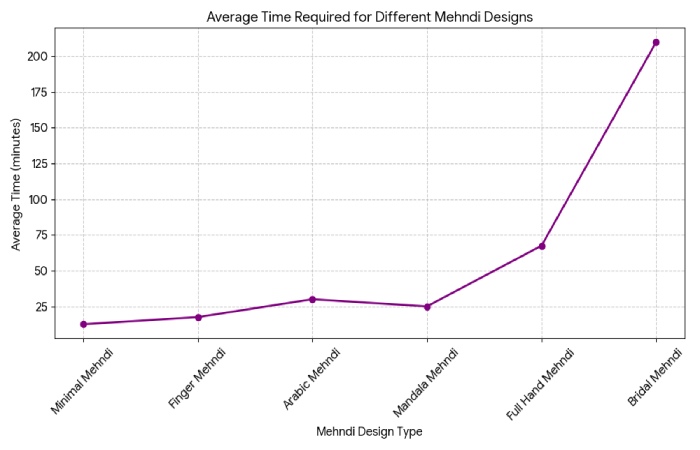
Mehndi Design Application Time
Average Time Required for Different Mehndi Designs
Mehndi Design Practice Guide for Beginners
Consistent practice improves line control and pattern balance.
| Practice Exercise | Skill Developed |
| Straight lines | Cone control |
| Circles and mandalas | Symmetry |
| Paisley shapes | Pattern complexity |
| Flower patterns | Decorative detail |
Professional mehndi artists recommend practicing on paper or plastic sheets before applying on skin.
Tools Used by Professional Mehndi Artists
Experienced artists often customize cone size and paste consistency for different design styles.
| Tool | Purpose |
| Henna cone | Main applicator |
| Jacquard bottle | Precision designs |
| Stencil sheets | Beginner templates |
| Cotton swabs | Error correction |
| Essential oils | Enhance stain color |
Aftercare Tips for Dark Mehndi Stain
Proper aftercare dramatically affects the final color.
| Tip | Benefit |
| Leave paste longer | Darker stain |
| Apply lemon-sugar solution | Moisture retention |
| Avoid water for 12 hours | Prevent fading |
| Use natural oils | Enhance stain longevity |
The stain usually darkens within 24–48 hours.
Common Mistakes Beginners Make
Avoiding these mistakes speeds up skill development. Professional artists emphasize patience and a steady hand.
| Mistake | Result |
| Using old henna | Weak stain |
| Pressing cone too hard | Thick uneven lines |
| Overfilling designs | Loss of pattern clarity |
| Not practicing symmetry | Unbalanced designs |
Safety Considerations When Using Mehndi
Natural henna is generally safe for skin when used correctly.
However, black henna should be avoided because it may contain PPD (para-phenylenediamine), a chemical linked to skin reactions. Always choose pure, plant-based henna powder.
| Type | Safety Level |
| Natural henna | Safe |
| Organic henna | Safe |
| Black henna | Risky |
FAQs About Mehndi Design</strong>
How long does mehndi last?
Most mehndi stains last 7–14
days, depending on skin type and aftercare.
Why does the mehndi color get darker the next day?
Henna dye molecules oxidize when exposed to air, deepening the stain color.
Can beginners learn mehndi easily?
Yes. Starting with simple Arabic patterns and basic shapes helps beginners develop skills quickly.
How can I make my mehndi darker?
Use these methods:
- Leave paste for 6–8 hours
- Apply lemon-sugar sealant
- Avoid water exposure initially
- Use high-quality henna powder
Final Thoughts
Mehndi design is more than decorative body art—it is a centuries-old cultural practice that blends symbolism, creativity, and craftsmanship. For beginners, starting with simple Arabic patterns and mastering basic shapes builds the foundation needed for more complex styles like bridal or Pakistani mehndi.
As modern trends introduce minimalist, personalized, and fusion designs, mehndi continues to evolve while preserving its cultural heritage. Whether applied for weddings, festivals, or fashion, the beauty of mehndi lies in its temporary yet deeply expressive artistry.
Disclaimer: This guide is for educational and inspirational purposes. Always use 100% natural henna and perform a patch test 24 hours before full application to rule out allergies. We are not medical professionals.