

Everybody Deserves The Kitchen of Their Dreams

For any individual, the single most challenging part of finding an exquisite kitchen design is mustering the ability to step back and assess whether you wholeheartedly like something, or if you have been maneuvered into the illusion that you wanted it. This phenomenon, of dealing with an orchestrated preference masquerading as your own, is indeed very common. Actually, it has become a quasi-inescapable sociocognitive inevitability, particularly as we inhabit an era in which social media functions as a hyper-amplified apparatus of epistemic modulation. Without even the slightest tincture of hyperbolic distortion, it is worth noting that nowadays we are subjected to an incessant cascade of neuroaesthetic stimuli, engineered to insinuate themselves into the architecture of our desire.
Your kitchen should also complement the character of the home around it. If you are exploring broader residential inspiration, looking at a can help you visualize how exterior architecture and interior style can work together.
Furthermore, it is about time we emphasized that the decision to inscribe THEIR in capital letters within the title was no incidental typographic flourish, but an intentional semiotic provocation. The entire fulcrum of the argument rests here:
- Your aspirations regarding the perfect kitchen design ought to remain sovereignly yours, rather than subsumed into the gravitational pull of THEIR projected desiderata.
At this juncture, one might be tempted to concede that discerning whether a preference is genuinely self-generated or subtly inculcated by societal conditioning becomes an almost impossible epistemic undertaking. Well, your inference is by no means wrong. Consequently, we invite you to take a subtle rewiring of your cognitive circuitry.
Traditional Kitchens
Imagine, for a moment, that the fleeting spectacle of trends leaves you entirely unmoved and that your sensibilities lean toward the enduring, the classical, and the unquestionably refined. If that is the case, a traditional kitchen will likely align with your aesthetic convictions. This design philosophy traces its lineage to the gracious homes of the eighteenth and nineteenth centuries, an era in which craftsmanship and cultivated taste were not mere preferences but expected standards. Within such spaces, one encounters an orchestration of rich materials, among them polished wood, stone, granite, marble, and ceramic, each contributing its own quiet gravitas.
The palette that animates a traditional kitchen is drawn from the natural world. You will see creamy whites, warm terracotta, gentle bronzes, golds that glow without ostentation, tranquil blues, and spirited greens. Together they compose an atmosphere that feels grounded, warm, and deeply inviting. The most distinctive element, however, lies in the cabinetry, which resembles fine furniture rather than simple storage. The doors frequently bear intricate carvings, softened edges, delicate moldings, and artfully crafted panels, whether raised, flat, shaker style, or fitted with glass that reveals curated displays. Naturally, all these details converge to create an environment where quiet luxury reigns, where coffered ceilings, polished stone counters, columns, and wainscoting form an impression of elegance that asserts itself without ever becoming theatrical.
Traditional design works particularly well when the rest of the property carries a similarly timeless character. Exploring can provide additional inspiration for creating a cohesive look across the home’s exterior and interior spaces.
Contemporary Kitchens
The transition from the traditional to the contemporary may appear abrupt, yet this very contrast is what renders interior design so intriguing. The contemporary approach appeals to those who navigate change with ease and who find delight in the evolving rhythm of modern aesthetics. It is a style that refuses to remain static. Instead, it responds instinctively to shifts in technology, materials, and cultural preference, renewing itself year after year.
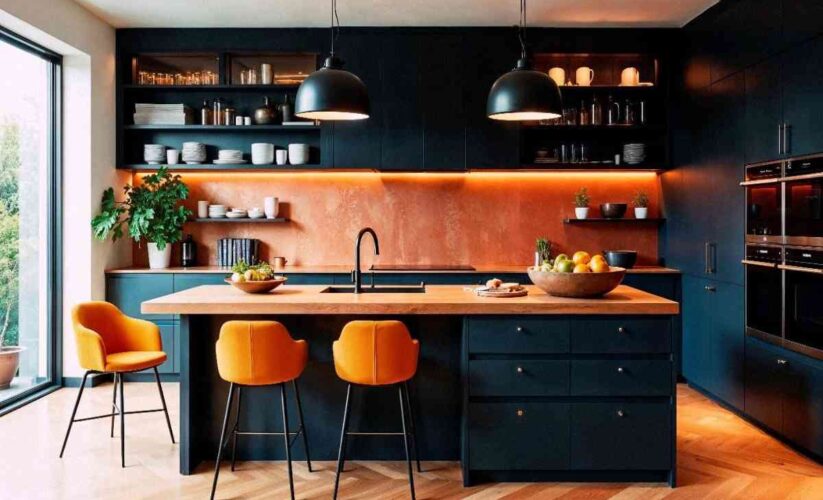
Although many associate contemporary design with minimalism, the truth is more nuanced. Today’s contemporary kitchen possesses a certain dramatic flair, a willingness to juxtapose textures, colors, and shapes in ways that feel bold yet refined. While a neutral palette remains a familiar foundation, one increasingly encounters adventurous hues such as deep matte black, saturated turquoise, velvety brown, vivid tangerine, lively lime green, or striking red. Here, the decorative landscape is equally varied. For instance, a cascading chandelier may become the focal point of the room, a sculptural pendant light may create a moment of artistic tension, or vast windows may invite extraordinary expanses of daylight. In a contemporary kitchen, personal expression is not merely permitted but encouraged, so long as the overall composition retains a sense of coherence and visual harmony.
Modern Kitchens
Modern kitchens occupy a fascinating position at the intersection of tradition and contemporary sensibilities. Although the terms modern and contemporary are often use interchangeably in casual conversation, they refer to distinct aesthetic languages. Furthermore, modern design emerged during the early twentieth century, propelled by a desire to abandon excess ornamentation and embrace instead the clarity of function and form. Influenced by the Bauhaus movement, the modern kitchen celebrates smooth surfaces, neutral colors, simple geometries, and abundant natural light.
Horizontal lines play a decisive role in shaping the character of a modern space, guiding the eye across backsplashes, cabinetry, flooring, and tile arrangements with deliberate calm. Given its devotion to function, the modern kitchen typically includes expansive islands, generous storage, and layered lighting solutions that allow the room to shift effortlessly from practical workspace to elegant gathering area. The color combinations within this style can be remarkably expressive, uniting contrast and harmony in unexpected ways.
A modern kitchen can also become part of a larger entertaining environment rather than remaining an isolated indoor space. For homeowners who want to extend that experience beyond the kitchen, can help create connected outdoor areas for dining, relaxing, and entertaining.
Bonus: Unlike other kitchen designs, where cabinetry is an immutable edifice, today’s modern kitchens possess a latent recuperative grace, that of absorbing transformation with minimal violence.
Cottage Kitchens
The cottage kitchen represents a gentle fusion of vintage warmth and contemporary comfort. It draws from both traditional and farmhouse influences, yet it transforms them with an unmistakable romantic softness. This design evokes nostalgia, recalling an era when quality measure not by brand recognition but by the sincerity of craftsmanship and the quiet charm of everyday living. Furthermore, a signature feature of this style is the farmhouse sink, with its deep basin and broad silhouette, a piece that embodies both beauty and practical purpose. Wooden elements abound in cottage kitchens. One finds them in countertops, cabinetry, and flooring, all harmonizing with exposed beams that introduce texture, warmth, and a faint echo of rustic tradition. The result is a kitchen that feels intimate, comforting, and profoundly human, a space where the past and present coexist with remarkable ease.